×

What Is GEO? Generative Engine Optimisation Guide 2025

AI advisor recommending brands — representing generative engine optimisation across ChatGPT, Gemini, and Perplexity

What is GEO? Generative Engine Optimisation — The Complete Guide for 2025

How to ensure your brand is cited, recommended, and trusted by the AI platforms your buyers are using today

Category: Education | GEO Fundamentals | Read time: 12 min read

AI advisor recommending brands — representing generative engine optimisation across ChatGPT, Gemini, and Perplexity

When the Search Engine Becomes the Advisor

Imagine that instead of your buyer typing a query into Google and receiving a list of links to browse, they simply describe their business challenge to an intelligent advisor — who synthesises everything available on the topic and gives them a considered, specific recommendation.

That advisor increasingly exists. It is ChatGPT, Gemini, Perplexity, Claude, and a growing ecosystem of AI platforms that are rapidly becoming the first port of call for professional research, vendor evaluation, and strategic decision-making.

Generative Engine Optimisation is the practice of ensuring your brand is the one that advisor recommends.

KEY INSIGHT

ChatGPT surpassed 800 million weekly active users by late 2025 — more than the population of Europe. Perplexity AI processed 780 million queries in May 2025 alone, a 239% increase in under a year. These platforms are not supplements to Google. For a growing segment of business buyers, they are the primary research tool.

The Fundamental Difference: GEO vs Traditional SEO

Understanding GEO begins with understanding how it differs from the SEO you are probably already familiar with.

Traditional SEO is about ranking. You compete to appear in the top positions of a list that a buyer then browses. Your goal is to be clicked.

GEO is about citation. You compete to be included in a synthesised answer that a buyer receives directly. Your goal is to be recommended.

The difference might seem subtle but its commercial implications are significant. A traditional SEO ranking is one option among many. A GEO citation is an endorsement. When an AI assistant recommends your brand — either explicitly by naming it or implicitly by structuring its answer around your content — it carries the weight of an objective third-party recommendation.

Buyers trust AI recommendations. Edelman's research consistently shows that algorithmic and AI recommendations are perceived as more objective than advertising or marketing content. Being recommended by an AI is not just visibility — it is credibility.

How AI Engines Decide What to Cite

AI platforms do not select sources randomly or exclusively on the basis of traditional SEO signals. Their selection process is shaped by several factors that are distinct from — though partially overlapping with — conventional search ranking criteria.

Training Data Familiarity

Large language models are trained on vast amounts of text data. Brands and content sources that appear frequently and consistently in high-quality publications, research, and professional writing are more likely to be familiar to the model before a user even asks a question. This 'ambient authority' is difficult to manufacture but possible to build through consistent thought leadership and external publication.

Retrieval and Real-Time Crawling

Many AI platforms — including Perplexity, Bing Copilot, and Google's AI Overviews — actively crawl the web to supplement their training data with current information. For these platforms, the same signals that influence traditional search crawlability matter for AI visibility: clean technical infrastructure, clear content structure, and absence of barriers to access.

Structured Data and Schema

Research by Semrush found that schema markup improved AI information extraction accuracy from 16% to significantly higher levels in controlled tests. Pages that explicitly label their content through JSON-LD structured data give AI systems a clear framework for understanding what the content is, who produced it, and what questions it addresses. This is not a minor detail — it is foundational to reliable AI citation.

Specificity and Citable Claims

AI systems are significantly more likely to cite content that contains specific, attributable claims than content making vague assertions. The reason is straightforward: specific claims are verifiable, unambiguous, and quotable. A claim that 'companies using X approach see improved results' offers nothing citable. A claim that 'organisations implementing structured content programmes saw a 40% average increase in AI citation frequency, according to a Princeton University study' is specific, attributable, and extractable.

Third-Party Validation

AI systems weight content that has been validated by external sources — third-party links, media mentions, directory citations, and social references — more heavily than content existing only on a brand's own website. This is analogous to the difference between self-reporting and independent audit. A brand that tells the world it is an authority is less credible than a brand that other authoritative sources describe as an authority.

The GEO Visibility Gap — and Why It Compounds

One of the most challenging aspects of poor GEO performance is that it is largely invisible to the brand experiencing it. You will not receive a notification that an AI platform failed to recommend your business when a buyer asked for a recommendation in your category. You will not see it in your analytics. You will only see the downstream effect: slower growth, tighter pipelines, and the vague sense that competitors are performing better than their obvious advantages would suggest.

What makes this worse is the compounding dynamic. Brands that are consistently cited by AI systems earn stronger entity recognition over time. That recognition leads to more citations, which leads to stronger recognition. The gap between brands with strong AI presence and those without it is not static — it is widening.

Princeton University's research found that GEO can improve AI visibility by up to 40%. But that improvement is not available to all participants equally. It requires deliberate, structured effort. And every month without that effort is a month the compound gap grows larger.

KEY INSIGHT

The brands benefiting most from AI search visibility right now are not necessarily the largest or most established players in their categories. They are the ones who understood what was happening and invested in the right approach earliest. Early movers in GEO are establishing positions of authority that will be expensive and time-consuming for latecomers to challenge.

A Practical GEO Roadmap

Step 1: Establish Your Technical Foundation

Before any content or authority work, ensure AI platforms can access and accurately interpret your site. This means reviewing your robots.txt file to confirm AI crawlers are permitted, implementing Organisation and Service schema markup, deploying a clear llms.txt file at your domain root, and ensuring your most important content is available in the initial HTML rather than loaded dynamically by JavaScript.

Step 2: Build Answer-First Content

Restructure your key pages to lead with direct, specific answers to the questions your buyers are most likely to ask an AI assistant. Add FAQ sections to all service and product pages, with each answer designed to be extractable — beginning with the key point, supported by specific evidence, and structured to match the query type.

Step 4: Build External Entity Signals

Ensure your brand is consistently represented across Google Business Profile, LinkedIn, industry directories, and relevant third-party publications. Pursue contributed articles in publications your buyers read and your AI platforms are likely to treat as authoritative sources. Each external citation strengthens the AI's confidence in your brand as a recognised entity in your category.

Step 5: Monitor and Iterate

GEO performance requires active monitoring. Set up a regular practice of testing how AI platforms respond to category queries in your market. Tools such as Semrush's AI Visibility Score, Evertune, and Perplexity's built-in citation tracking provide structured ways to monitor progress. Manual testing — directly querying ChatGPT, Gemini, and Perplexity with the questions your buyers are most likely to ask — remains the most direct and revealing approach.

What GEO Means for Your Buyers' Experience

It is worth stepping back from the technical and strategic dimensions of GEO to consider what it means for the experience of your buyers.

A buyer who asks an AI assistant for a recommendation in your category and receives your brand's name in a considered, positive context is already partway through the trust-building process before they have interacted with your business at all. They arrive at your website — or your sales conversation — with the AI's implicit endorsement already in play.

A buyer who asks the same question and does not encounter your brand at any point is being guided away from you by one of the most trusted information sources in their professional life. That is the scale of the opportunity — and the risk — that GEO represents.

QUICK WINS: WHAT YOU CAN DO THIS WEEK

  1. Right now, open ChatGPT and ask: ‘Who are the best [your service category] providers in [your market]?’ Record exactly what it says — this is your GEO baseline.
  2. Check that GoogleBot, GPTBot, ClaudeBot, and PerplexityBot are all permitted in your robots.txt file. Blocking any of these is costing you AI visibility.
  3. Deploy Organisation schema markup on your homepage and Service schema on each service page. This is a one-time technical implementation that pays ongoing dividends.
  4. Create an llms.txt file at your domain root with a clear, concise briefing on who your company is, what you do, who you serve, and what makes you distinctive.
  5. Identify one genuinely original data point from your own work or client outcomes that no other brand in your category can claim. This is your highest-value GEO citation asset — build a piece of content around it.

READY TO TAKE ACTION?

GEO is the newest frontier of search — and the window of early mover advantage is still open, but it is narrowing. SAGE is Brandcore's integrated programme for SEO, AEO, and GEO, designed to build the kind of search dominance that compounds over time. Find out where you stand today with a complimentary SAGE Visibility Audit at brandcore.sg.
How an E-Commerce Brand Cut Paid Media Spend 40% | SAGE

E-commerce brand reducing paid media dependency by 40% through organic search growth with SAGE

SAGE Case Study: How an E-Commerce Brand Used Search Dominance to Reduce Paid Media Dependency by 40%

What happens when you stop renting visibility and start owning it

Category: Case Study | SAGE Results | E-Commerce | Read time: 10 min read

E-commerce brand reducing paid media dependency by 40% through organic search growth with SAGE

The Paid Media Trap

There is a particular kind of business anxiety that affects companies whose growth depends primarily on paid advertising. Every morning, the question is the same: what did we spend yesterday, and what did we get for it? Every month, the cost-per-acquisition creeps slightly higher. Every quarter, the pressure to maintain results while managing budget intensifies.

This was the situation facing a consumer lifestyle brand operating across Singapore and Malaysia when they engaged Brandcore for a SAGE optimisation programme. Their digital presence was almost entirely built on paid search and social advertising. Organic channels — SEO, content, and social organic — contributed less than 15% of their total digital traffic.

The brand had an excellent product, strong customer reviews, and a growing repeat purchase rate. But their discovery mechanism was rented, not owned. Every new customer cost money to acquire. There was no compounding asset working in their favour.

The SAGE Assessment: What the Audit Found

The SAGE audit revealed a brand with strong underlying commercial foundations but almost no organic search infrastructure. The website had not been technically optimised for search. There was minimal content beyond product descriptions and a sparse blog. The brand had no structured data implementation. And despite a strong customer base, there were no published testimonials, case studies, or social proof assets structured for search visibility.

Critically, when buyers searched for the product category in which the brand competed — a category generating over 50,000 monthly searches in the Singapore-Malaysia market — the brand appeared nowhere in the organic results. All of that search demand was being captured by competitors and content publishers, while the brand paid to intercept buyers after they had already formed initial preferences.

KEY INSIGHT

The paid media trap works like this: you get results, so you keep paying. The results feel like progress. But you are not building anything. Stop paying for a week, and your visibility evaporates entirely. The organic investment required to change this feels daunting — but the alternative is funding the trap forever.

The Strategy: Building an Owned Discovery Channel

The SAGE programme for this client focused on three interconnected objectives: establishing technical foundations for organic search, building topical authority in the brand's product category, and capturing AI search visibility for the discovery-stage queries that paid media was too expensive to target at scale.

Technical Foundations

A comprehensive technical audit identified forty-three actionable issues affecting crawlability and page performance. These ranged from duplicate content problems on product category pages to images lacking alt text, JavaScript-dependent content that AI crawlers could not parse, and page loading times that were above the threshold for Core Web Vitals compliance. All critical issues were resolved in the first six weeks of the programme.

Topical Authority: The Content Hub

The brand launched a content hub addressing the buyer questions and lifestyle topics most closely aligned with their product category. Rather than producing generic branded content, the hub was structured around the genuine questions their target buyers were asking — validated through keyword research, customer interviews, and analysis of the 'People Also Ask' boxes appearing in search results for category queries.

The content was structured for both reader value and AI extractability: clear H2 structures, answer-first opening paragraphs, FAQ sections with schema markup, and specific data points sourced from published research. Twelve substantial articles were produced in the first three months, covering the full informational arc from category education through to purchase decision support.

AI Search Presence

Schema markup was implemented across the site, including Product, Organization, FAQPage, and Article types. The brand's presence on third-party platforms — review sites, lifestyle publications, social channels — was audited for consistency and completeness. Three content collaborations were arranged with credible lifestyle and category-specific publications, generating external links and citations that strengthened the brand's authority signals for AI platforms.

Results at 12 Months

Organic Traffic Growth

Total organic search traffic increased by 218% over the twelve-month period. Direct organic traffic to the content hub reached 24,000 sessions per month by month twelve, from zero at the programme's start. Seventeen article pages achieved page one rankings for their target queries, including four in the featured snippet position.

AI Search Visibility

The brand appeared in AI-generated responses on Perplexity for eleven category queries — including six discovery-stage queries representing buyers at the earliest stage of the purchase consideration process. Google AI Overviews featured the brand's content in responses to five product category queries. The brand was cited in ChatGPT responses to three category recommendation queries tested during the audit.

Paid Media Impact

With organic discovery increasing, the brand was able to reduce paid search spend on top-of-funnel awareness campaigns by 40% while maintaining equivalent new customer acquisition volumes. The budget freed by this reduction was reallocated to bottom-of-funnel retargeting, which became more efficient as brand awareness and recognition improved through organic channels.

Total digital marketing cost-per-acquisition decreased by 34% over the twelve-month period.

Revenue Impact

Organic search became the brand's second-largest customer acquisition channel by month nine, overtaking social advertising for the first time. Customers acquired through organic search had an average order value 22% higher than paid search customers, a pattern the brand attributed to the pre-qualification effect of educational content — buyers who had consumed category and product guidance content before purchasing were more confident and more likely to choose premium options.

KEY INSIGHT

The most striking insight from this engagement was the compounding dynamic. By month twelve, the organic traffic gains were accelerating rather than plateauing. The authority built in months one through six was generating additional authority in months seven through twelve. Paid media performance, by contrast, required constant spending to maintain results. Organic search was becoming a self-reinforcing asset.

Why This Works: The Economics of Owned Visibility

Paid media is a variable cost. Spend stops, results stop. Organic search is a capital asset. Effort invested today generates returns tomorrow, next year, and the year after. The economics are fundamentally different.

A business that has built strong organic search visibility has created a customer acquisition channel that does not require ongoing payment for each impression and click. The cost of maintaining that channel — producing continued content, maintaining technical standards, building authority through partnerships — is substantially lower than the cost of generating equivalent visibility through paid media.

More significantly, organic and AI search visibility creates a different kind of buyer. Someone who found your brand through a paid advertisement is a buyer you interrupted. Someone who found your brand because an AI recommended it, or because your content appeared as the authority on a question they were researching, is a buyer who was guided to you. The psychological context is entirely different — and the conversion rates, deal sizes, and retention metrics reflect that difference.

QUICK WINS: WHAT YOU CAN DO THIS WEEK

  1. Calculate what percentage of your current new customer acquisition is paid versus organic. If paid exceeds 70%, you have a significant dependency risk worth addressing urgently.
  2. Map your five highest-volume product or service category search terms. Are you ranking organically for any of them? If not, each one represents a stream of buyer intent you are not capturing.
  3. Review your product or service pages for buyer-question content. If the pages only describe what you sell rather than answering why a buyer should choose it and how it solves their specific problem, they need restructuring.
  4. Identify one or two credible industry or lifestyle publications relevant to your category. A contributed article or product feature with a link back to your site will have lasting SEO and authority value.
  5. If you have strong customer reviews, structure them for AI visibility. Specific, outcome-focused testimonials are vastly more likely to be cited by AI systems than generic positive feedback.

READY TO TAKE ACTION?

Paid media will always have a role. But if it is your primary discovery channel, you are renting visibility you could own. SAGE is how you make the transition — systematically, measurably, and with a clear ROI framework. Book a SAGE Strategy Session at brandcore.sg to understand exactly what owned search could look like for your business.

Search Dominance in 6 Months: B2B SAGE Case Study | Brandcore

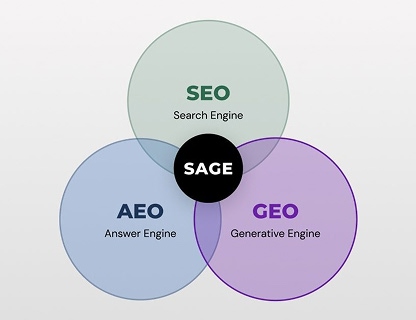
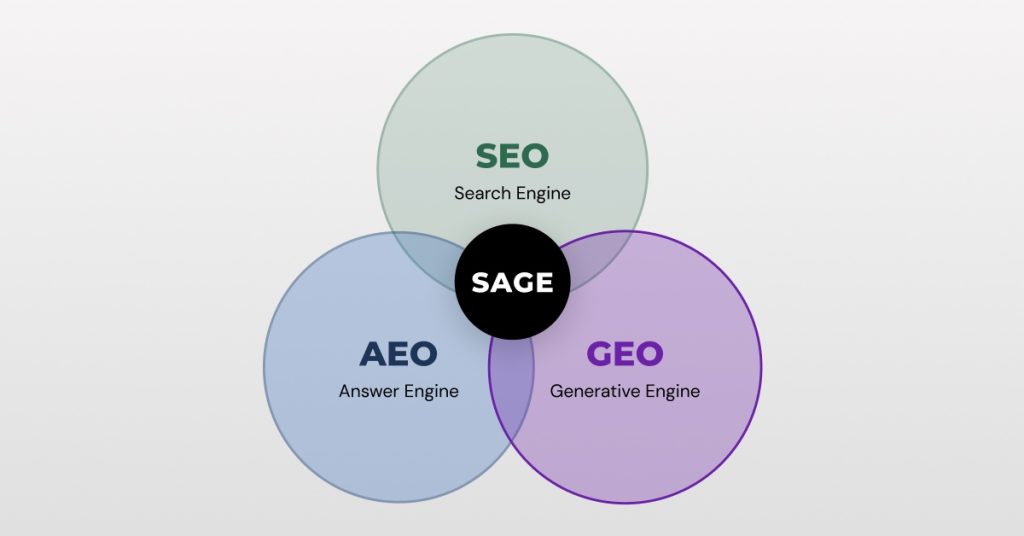
SAGE by BRANDCORE is an integrated SEO, AEO, and GEO strategy.

SAGE in Action: How a B2B Professional Services Firm Achieved Search Dominance in 6 Months

A detailed case study in integrated SEO, AEO, and GEO — with real metrics

Category: Case Study | SAGE Results | Read time: 11 min read

The Problem: Invisible Despite Investment

A regional professional services firm — providing compliance, risk advisory, and governance consulting to mid-market companies across Southeast Asia — had been investing in digital marketing for three years when they engaged Brandcore. They had a well-designed website, a consistent content programme, and an agency relationship that had delivered modest but respectable Google rankings for their core service keywords.

On paper, their digital presence looked functional. In practice, it was not working.

Qualified inbound leads had plateaued for eighteen months. Their sales team was generating most new business through referrals and direct outreach. When asked directly, the firm's leadership could not confidently say whether a prospective client searching for their services online would encounter their brand in any meaningful way.

The diagnostic phase of the SAGE engagement confirmed their suspicion. The firm ranked on page one for several branded and generic keywords. But they were entirely absent from featured snippets, Google AI Overviews, and AI assistant recommendations for the most commercially significant queries in their category.

KEY INSIGHT

When the engagement team asked ChatGPT 'what are the best compliance advisory firms in Southeast Asia,' the client's brand was not mentioned. Three direct competitors were. One of those competitors had been founded three years after the client and had approximately one-third of the client's revenue. Their AI visibility had no relationship to their real-world standing — which meant that AI search was actively distorting the competitive landscape in favour of a smaller, newer competitor.

The Diagnosis: Three Structural Gaps

The SAGE audit identified three structural gaps that were collectively responsible for the firm's AI search invisibility.

Gap 1: Content Written for Rankings, Not Answers

The firm's existing content was structured to perform in traditional search: articles with keyword-rich headings, adequate word counts, and internal links. But none of the content was written to answer specific buyer questions directly. The articles explored topics at length without ever synthesising a clear, citable conclusion. An AI scanning the site for an answer to 'how should a CFO approach regulatory compliance risk' would find extensive discussion of the topic but no extractable, structured answer.

Gap 2: No Structured Data or Schema Implementation

The firm's website had no schema markup of any kind. There was no Organisation schema establishing the firm as a clearly identifiable entity, no Service schema defining its offerings, and no FAQPage schema on any of its content pages. For AI systems that rely on structured data to accurately interpret and cite content, the website was effectively presenting itself in an unlabelled box.

Gap 3: Thin Entity Signals

The firm's name appeared consistently on its own website and LinkedIn profile, but its presence across third-party sources was sparse. There were limited directory listings, no published case studies with specific metrics, and minimal media mentions. Without these external entity signals, AI platforms had little basis on which to establish the firm as a recognised authority in its category.

The SAGE Implementation: What Was Done

Phase 1 (Weeks 1–4): Technical and Entity Foundation

The first phase addressed the structural and technical gaps before any content investment was made. Organisation, Service, and FAQPage schema were implemented across the site. The robots.txt file was reviewed and updated to ensure AI crawlers were permitted access to all relevant pages. The firm was listed consistently across twelve relevant third-party directories. A detailed llms.txt file was created and deployed at the domain root, providing AI systems with a clear briefing on the firm's expertise, services, and key differentiators.

Phase 2 (Weeks 5–10): Content Architecture Rebuild

The firm's top fifteen service and thought leadership pages were restructured using an answer-first format. Each page was rewritten to open with a direct, specific response to the most commercially important question that page was designed to address. FAQ sections were added to all service pages, drawing on questions the sales team had identified as the most common in buyer conversations. Each FAQ answer was structured to be extractable — beginning with the key point rather than building to it.

A pillar content programme was initiated across three topic clusters directly aligned with the firm's core service areas: regulatory compliance frameworks, governance for growth-stage companies, and risk management in cross-border operations. Two long-form articles were published per month, each containing specific, attributed data and structured for both reader comprehension and AI citation.

Phase 3 (Weeks 11–24): Authority Building and External Citation

The third phase focused on building the external authority signals that AI systems use to validate a brand's standing in its category. This included a targeted programme of contributed articles to three relevant regional publications, participation in two industry roundtables that generated media coverage, and the development of three case studies with client permission — each written with specific percentage improvements, timeline data, and named client context.

The Results: Six-Month Performance

The following results were measured at the six-month mark relative to the pre-engagement baseline.

Search Visibility

Featured snippet appearances for target queries increased from 2 to 19 — a 850% increase. The firm appeared in Google AI Overviews for 11 of its 25 target queries, compared to zero at the start of the engagement. Organic traffic to service pages increased by 63% over the period.

AI Search Citation

At the six-month mark, the firm appeared in ChatGPT's responses to four of the five category queries tested at engagement start, including the compliance advisory recommendation that had originally showed three competitors. Perplexity cited the firm in responses to six category queries. Google Gemini included the firm in AI Overview content for three of its core service areas.

Commercial Impact

Qualified inbound leads increased by 48% compared to the equivalent prior period. The sales team reported that prospects arriving via organic search were more informed, more specifically aware of the firm's differentiated approach, and more likely to be evaluating the firm as a primary rather than fallback option. Average deal cycle length decreased by 22% — a result the sales director attributed directly to buyers arriving having already encountered the firm's thought leadership content.

Cost Per Qualified Lead

Cost per qualified inbound lead decreased by 31% over the period, reflecting the combination of increased organic traffic and improved lead quality from better pre-educated prospects.

KEY INSIGHT

Perhaps the most significant result was not a metric but an observation. At the end of the six-month engagement, the firm's leadership team ran the original diagnostic test: they asked ChatGPT for a recommendation in their category. This time, their firm was named first. Their smaller competitor, who had led the AI results at the start of the engagement, was no longer mentioned.

Key Lessons from This Engagement

Several principles from this engagement are broadly applicable to B2B professional services firms considering a similar approach.

Technical implementation precedes content investment: Schema markup, crawlability, and entity establishment are the foundations. Content improvements built on a weak technical foundation deliver a fraction of their potential impact.

Answer-first content outperforms topic-coverage content: The restructured pages with direct, specific answers consistently outperformed the original topic-exploration format in both rankings and AI citation frequency.

External validation matters to AI systems: The published case studies and third-party media appearances had a disproportionate impact on AI citation — significantly more than equivalent internal content. AI systems weight independent validation heavily.

Results compound: The improvements at six months were already accelerating. Authority builds on authority. Early investments in structured content and entity signals delivered returns that grew larger, not smaller, as the engagement progressed.

QUICK WINS: WHAT YOU CAN DO THIS WEEK

  1. Ask yourself the diagnostic question: if a buyer asked ChatGPT for a recommendation in your category today, would your brand appear? If you don’t know the answer, test it immediately.
  2. Identify your three most commercially important service areas and audit whether each has a dedicated page that answers the primary buyer question directly in the first paragraph.
  3. Review your case studies. If they lack specific metrics, percentage improvements, and timeline data, they are unlikely to be selected as AI citation sources.
  4. Check whether your brand appears consistently and completely in the top relevant industry directories for your market. Inconsistent name, address, or service descriptions weaken entity signals.
  5. Consider a targeted content contribution to one or two credible industry publications. External citation from authoritative third-party sources is one of the highest-impact authority signals available.

READY TO TAKE ACTION?

The results in this case study were achieved through a structured, evidence-based process — not guesswork or shortcuts. If your business is ready to take the same approach to your search presence, a SAGE Strategy Session is the starting point. Book yours at brandcore.sg.

What Is AEO? Answer Engine Optimisation for B2B | SAGE

Person asking voice assistant a question — representing answer engine optimisation for featured snippets

What is AEO? Answer Engine Optimisation Explained for B2B Brands

How to become the definitive answer in your industry — and why it matters more than you think

Category: Education | AEO Fundamentals | Read time: 10 min read

Person asking voice assistant a question — representing answer engine optimisation for featured snippets

The Question Has Changed. Has Your Answer?

Not long ago, a buyer researching a business challenge would type a few keywords into Google, receive a page of results, and begin clicking through to evaluate their options. The search engine's job was to serve a list. The buyer's job was to browse the list and decide what to read.

That model is still in use. But it is being supplemented — and in some contexts replaced — by a different pattern. Buyers are increasingly typing full questions into search engines and AI tools, and expecting a direct, synthesised answer rather than a list of options to browse.

When a buyer types 'what is the best approach to B2B lead generation for professional services firms,' they are not looking for a list of websites. They are looking for an answer. Answer Engine Optimisation is the discipline of ensuring that your brand provides that answer.

KEY INSIGHT

Featured snippets — the direct answers that appear at the top of a Google results page, before the ranked list — receive a disproportionate share of clicks for informational queries. For B2B buyers conducting research, appearing as the featured answer for a relevant question is more valuable than ranking first in the traditional list below it.

What Exactly is Answer Engine Optimisation?

Answer Engine Optimisation (AEO) is the practice of structuring your content to be selected by search platforms as the definitive answer to specific queries. It encompasses both the traditional featured snippets that appear at the top of Google results pages and the direct answers generated by AI-powered search tools such as Google's AI Overviews, Bing Copilot, and voice assistants.

If SEO is about being on the shelf in the library, AEO is about being the book the librarian hands directly to someone who walks in and asks a specific question. You are not competing for browsing traffic. You are being selected as the authority.

How Answer Engines Select Their Sources

Answer engines do not choose sources at random. They apply several consistent criteria in assessing which content deserves to be presented as the definitive answer.

Clarity of Response

The content that wins featured positions typically answers the question directly in the first few sentences, without preamble or excessive qualification. An answer engine scanning a page for a response to 'what is AEO' will prefer content that begins with a clear, explicit definition over content that takes three paragraphs to establish context before defining the term.

Structural Appropriateness

Different query types favour different structural formats. A 'how to' question is best answered with a numbered step-by-step list. A 'what is' question is best answered with a concise definition paragraph. A comparative question ('X versus Y') is best answered with a structured table. AEO content is written and formatted with the query type in mind, not only with the reader in mind.

Source Authority

Even a perfectly structured answer will not be selected if it comes from a source with no established credibility. Answer engines weight source authority heavily. This is the intersection of SEO and AEO: you need the foundational authority signals of traditional SEO to be eligible for the featured positions that AEO targets.

The High Cost of Being the Second-Best Answer

In traditional SEO, the difference between ranking first and ranking second is significant but not dramatic. Studies suggest the top Google result receives roughly 30% of clicks, with the second position receiving around 15%. The gap is real, but both positions deliver traffic.

In answer engine contexts, the dynamic is far more binary. There is one featured answer. There is no second place. If your brand is the second-best answer to a question a buyer is asking, you are effectively absent from that interaction.

For B2B brands that rely on being discovered at the research stage of the buying process, this binary nature of AEO makes the stakes considerably higher. The brand that earns the featured position on the questions buyers ask during their evaluation process gains an implicit endorsement from the search platform itself. That endorsement is worth more than any advertising spend can replicate.

KEY INSIGHT

The consequence of missing AEO is not always visible in your analytics. You will not see the traffic you did not receive. You will not know which buyers were directed to your competitor because they appeared as the authority on the questions your buyers were asking. The damage is real but silent — which makes it more dangerous, not less.

How to Optimise for Answer Engines: A Practical Framework

Map the Questions Your Buyers Are Actually Asking

AEO begins with buyer question research. Use tools such as Google's 'People Also Ask' feature, keyword research platforms, and your own sales team's knowledge to compile the twenty to fifty questions that your target buyers most commonly ask when researching the problems your business solves.

These questions become the editorial brief for your AEO content strategy. Each significant question deserves a dedicated piece of content structured explicitly to provide the best available answer.

Answer First, Context Second

The single most common structural error in B2B content is burying the answer. Long introductions, extensive scene-setting, and extended disclaimers push the actual response down the page — past the point where an answer engine is likely to extract it.

Effective AEO content leads with the answer. The first paragraph of a 'what is' article should contain a clear definition. The first step of a 'how to' article should be the first real action. Everything else provides context and depth for readers who want to go further.

Use Schema Markup for FAQs and HowTo Content

Schema markup is a technical implementation that communicates your content's structure explicitly to search engines in a machine-readable format. FAQPage schema, applied to a page that contains question-and-answer content, tells Google directly that this page contains answers structured for featured positions.

Studies have found that pages with valid FAQ schema appear 20 to 30% more often in AI-generated summaries than equivalent pages without structured markup. This is one of the highest-return technical investments available to B2B content teams.

Match Format to Query Type

A question asking 'how do I build an SEO content strategy' calls for a numbered list. A question asking 'what is the difference between SEO and AEO' calls for a comparison table or clearly structured definition pair. A question asking 'why is AI search important for B2B' calls for a short, declarative paragraph with supporting evidence.

Formatting your answer to match the query type is not just user-friendly — it is a direct signal to the answer engine that your content is the right match for that type of search.

AEO and AI Search: The Connection You Cannot Ignore

The practices that make content effective for traditional featured snippets are the same practices that make content effective for AI-generated answers. Well-structured, specific, authoritative content that directly addresses buyer questions performs well across both environments.

This means that an investment in AEO is not siloed. It is simultaneously an investment in your presence in Google's featured positions, Google's AI Overviews, voice search responses, and the AI-generated answers produced by ChatGPT, Perplexity, Gemini, and every other platform in the generative AI ecosystem.

AEO is, in practice, the bridge between traditional SEO and full generative engine optimisation. Brands that build this bridge now will be significantly better positioned than those who wait to see how the landscape settles.

QUICK WINS: WHAT YOU CAN DO THIS WEEK

  1.  Search for your five most important service areas on Google and note which brands appear in featured snippets. Analyse the structure of their answers — then assess whether your content matches that format.
  2.  Add a dedicated FAQ section to your three most important service pages. Write each Q&A pair with the answer in the first sentence and keep answers under 100 words.
  3. Implement FAQPage schema on any page containing structured question-and-answer content. This is a one-time technical implementation with long-term compounding benefit.
  4. Review your blog article introductions. If the answer to the implied question in the headline does not appear in the first paragraph, rewrite the opening.
  5. Use Google’s ‘People Also Ask’ feature for each of your core service areas. Every question listed there is a potential AEO content target for your strategy.

READY TO TAKE ACTION?

AEO is where many B2B brands are losing ground right now — silently, invisibly, and cumulatively. A SAGE audit will identify exactly which questions in your category are being answered by your competitors instead of you, and what it would take to change that. Book your session at brandcore.sg.

What Is SEO in 2025? Complete Guide for Business Leaders

Google catalogues and ranks website content for SEO

What is SEO in 2025? A Complete Guide for Business Leaders

Beyond keywords and rankings — what search engine optimisation actually means for your business today

Category: Education | SEO Fundamentals | Read time: 9 min read

Google catalogues and ranks website content for SEO

SEO Is Not What Most People Think It Is

Ask ten business leaders what SEO is, and the majority will say something about keywords, rankings, and showing up on Google. They are not wrong. But they are describing the mechanics rather than the purpose — and that distinction matters more today than it ever has.

Search engine optimisation is, at its core, the practice of making your business the most credible and visible answer to the questions your buyers are asking. The keywords and rankings are instruments in service of that goal. They are not the goal itself.

This distinction matters because the instruments are changing. The goal is not.

How Search Engines Work — The Library Analogy

A useful way to think about how search engines function is to imagine the world's largest library, with billions of books, articles, and documents arriving every day. The library has a remarkably efficient cataloguing system: it reads every document, understands what it is about, assesses how credible and authoritative it appears to be, and decides where to file it.

When a user submits a search query, the library retrieves the documents most likely to answer the question and presents them in order of relevance and authority. The higher your document ranks, the more visitors it receives.

SEO is the practice of writing and presenting your documents so that the library's cataloguing system recognises them as highly relevant and authoritative for the queries that matter to your business.

The Three Pillars of SEO: Technical, Content, and Authority

Technical SEO

Before a search engine can rank your content, it must be able to find and read it. Technical SEO addresses the infrastructure of your website: how quickly pages load, whether they function correctly on mobile devices, how the site is organised and internally linked, and whether the pages are structured in a way that allows search engines to process them efficiently.

A common analogy: technical SEO is the foundations and load-bearing walls of your building. If these are weak, every other improvement you make is compromised.

Content SEO

Content is what your website says and how it says it. Effective content SEO means producing material that addresses the specific questions and challenges of your target audience, uses the language those buyers actually use, and is organised clearly enough that both readers and search engines can extract value from it quickly.

The mistake most businesses make in content SEO is writing for themselves — producing articles about their own products, services, and achievements — rather than for their buyers. Search engines reward content that serves genuine buyer intent. Content that exists primarily to promote the business rather than inform the reader performs consistently worse.

Authority SEO

A search engine does not only assess what your content says. It assesses how much credibility your content carries. The primary signal of credibility is the quantity and quality of other reputable websites that link to yours — a digital endorsement system.

Authority is the hardest pillar to build and the hardest to replicate. It is earned through a combination of excellent content that others want to reference, active relationship-building with publishers and partners, thought leadership that creates genuine value in your industry, and the patience to let a reputation compound over time.

KEY INSIGHT

Authority in SEO works like reputation in business. You cannot buy it, shortcut it, or fake it at scale. But once built, it becomes a durable competitive advantage that new entrants find extremely difficult to overcome.

What SEO Looks Like in 2025

SEO in 2025 is considerably more sophisticated than the keyword-stuffing practices that dominated the discipline in its early years. Google's algorithm has evolved through hundreds of updates, many of which were specifically designed to penalise manipulative tactics and reward genuine quality.

Today's effective SEO practice centres on several key principles.

Search Intent Over Keyword Matching

Modern search engines understand context, not just words. A search for 'how to improve organic search visibility' is understood as a request for actionable guidance, not simply a query containing those specific words. SEO content must match the underlying intent of the query — whether the user wants information, wants to navigate to a specific site, wants to evaluate options, or is ready to make a purchase.

E-E-A-T: Experience, Expertise, Authoritativeness, Trustworthiness

Google's quality rater guidelines explicitly assess content against these four criteria. Content that demonstrates direct personal experience, genuine subject matter expertise, recognised industry authority, and transparent and accurate information is consistently preferred over content that lacks these signals.

For B2B brands, this means that content should be specific, attributed, and grounded in real-world application — not assembled from generic sources or padded with boilerplate.

Mobile-First and Core Web Vitals

Google indexes websites on the basis of their mobile performance rather than their desktop version. Core Web Vitals — measures of loading speed, visual stability, and interactivity — are formal ranking factors. A website that performs poorly on mobile or loads slowly is penalised, regardless of the quality of its content.

Why Some Businesses Invest in SEO and See No Results

SEO failure is rarely about a lack of effort. It is typically about a mismatch between effort and strategy. The most common reasons businesses see poor returns from SEO investment include the following.

Targeting the wrong keywords: Optimising for high-volume terms that attract large audiences but not your specific buyers. A Singapore marketing agency that ranks for 'marketing' is unlikely to see commercial benefit. One that ranks for 'B2B demand generation agency Singapore' is precisely where it needs to be.

Publishing without a strategic framework: Creating content based on what seems interesting rather than what buyers are actively searching for. Without keyword and intent research, content production is largely guesswork.

Expecting short-term results: SEO compounds over time. New content typically takes three to six months to rank, and authority builds over years rather than weeks. Businesses that judge SEO by its three-month impact will consistently underestimate and underinvest in one of the most durable marketing assets available to them.

Treating SEO as a standalone activity: SEO does not work in isolation. It is most effective when integrated with content strategy, thought leadership, PR, and increasingly with AEO and GEO. A search strategy that addresses only the traditional SEO layer is optimising for a narrower and narrower slice of the buyer journey.

QUICK WINS: WHAT YOU CAN DO THIS WEEK

  1. Run a Google search for your five most important service areas. Note which pages on your site rank — and whether the content on those pages genuinely addresses what a buyer with that query would want to know.
  2. Check Google Search Console for your site’s average position, click-through rate, and impressions. Pages with high impressions but low CTR often need better title tags and meta descriptions.
  3. Audit your three best-performing pages. Do they match the search intent of the queries driving traffic? Does the content lead naturally to an enquiry or conversion?
  4. Identify three competitors who consistently outrank you. Review their page structure, content depth, and internal linking. What are they doing that you are not?
  5. Review your page loading speed using Google’s PageSpeed Insights. If your mobile score is below 70, technical performance is likely costing you rankings.

READY TO TAKE ACTION?

SEO is a long game — but the right strategy from the start compounds significantly faster than one built without a clear framework. Book a SAGE Strategy Session to see exactly where your search presence stands and how to build it for 2025 and beyond.

Why Ranking #1 on Google Is No Longer Enough | SAGE

search dominance across SEO, AEO, and GEO channels

Search Dominance vs Traditional SEO: Why Ranking First Is No Longer Enough

The shift from search rankings to search presence — and why it changes everything

Category: Strategy | Search Dominance | Read time: 10 min read

search dominance across SEO, AEO, and GEO channels

First Place in a Race Nobody Is Running

For two decades, the goal of digital marketing was clear: rank on page one of Google. Ideally, rank first. The assumption was simple — the higher your position, the more traffic you received, the more leads you generated, and the more business you closed.

That assumption still has merit. Page one rankings still drive traffic. But an increasing number of buyers never see the ranked results at all.

Google's AI Overviews now appear on approximately 30% of all searches. For informational queries — the kind of research-driven searches that characterise the early B2B buying journey — that figure is considerably higher. When an AI overview appears, it answers the question directly at the top of the page. The ranked results sit below it. Many users never scroll past the AI-generated answer.

You can rank first and still receive zero traffic from that query. First place in a race that fewer people are watching than you think.

KEY INSIGHT

The shift is not from search to no-search. It is from search-as-browsing to search-as-asking. Buyers are not abandoning search engines. They are using them differently. And a strategy built entirely around rankings is not designed for the new behaviour.

What Search Dominance Actually Means

Search dominance is not about ranking first. It is about owning the entire conversation around the problems your buyers face and the solutions your business provides.

A search-dominant brand appears in ranked results. But it also appears in featured snippets and AI overviews. It is cited in AI-generated recommendations. Its content is the source material that other platforms draw upon when constructing answers. It is the brand that buyers encounter repeatedly, across multiple formats and channels, before they ever make contact.

Think of traditional SEO as winning a single battle. Search dominance is winning the entire campaign.

The Three Dimensions of Search Dominance

Search dominance operates across three dimensions that correspond directly to the SEO, AEO, and GEO framework.

Visibility: Does your brand appear in search results, featured positions, and AI-generated answers for the queries that matter most to your buyers? This is the reach dimension. You can only influence buyers you appear in front of.

Authority: When your brand appears, does it appear as a credible, specific, and trustworthy source? This is the credibility dimension. Appearing frequently with thin or generic content builds no advantage. Appearing consistently with authoritative, specific content compounds it.

Presence: Is your brand encountered before the buying process begins, during the research phase, and at the point of decision? This is the timing dimension. Brands that only appear when buyers are ready to purchase have missed most of the journey.

How Traditional SEO Creates False Confidence

One of the most dangerous positions a business can occupy is ranking well in traditional SEO while being entirely absent from AI-driven search. It creates a false sense of security. Your analytics show traffic. Your rankings report shows page one positions. Your team feels confident. But the metric you are measuring is not the one that matters most to the buying decisions being made right now.

Consider the journey of a typical B2B buyer in 2025. They become aware of a business challenge — perhaps their organic search traffic has declined, or a competitor has begun outperforming them in digital channels. They open an AI assistant and describe the problem. The AI synthesises an explanation and names several potential solutions. Your brand is not mentioned.

They conduct further research on the named providers. They return to Google to look for social proof. They search for 'SAGE optimisation reviews' or 'search dominance agency Singapore' — and now your SEO ranking does help. But you are competing for consideration in a race where a competitor has already established preference.

KEY INSIGHT

The brand that was recommended by AI at the start of the buyer's journey carries a credibility advantage into every subsequent interaction. Traditional SEO can help you win the Google search — but GEO determines whether you were even on the shortlist when the buyer first defined the problem.

Why Most SEO Agencies Are Selling Yesterday's Solution

This is not a criticism of SEO as a discipline. Technical SEO, content quality, and authoritative backlinks remain foundational. But many agencies continue to measure success in terms of keyword rankings and organic traffic volumes — metrics that made complete sense in 2015 and are increasingly incomplete in 2025.

An agency that delivers excellent keyword rankings but does not address your brand's presence in AI-generated answers is delivering partial results for full billing. The gap between what they measure and what drives your buyers' decisions is growing larger by the month.

The question to ask your current SEO provider: 'If a buyer asks ChatGPT who the best provider is in our category, will our brand appear?' If they cannot answer that question with confidence — and with a plan to influence the answer — you have an incomplete strategy.

The Five Pillars of a Search Dominance Strategy

Building genuine search dominance requires working across five interconnected areas simultaneously. Each pillar reinforces the others. Neglecting one weakens the whole structure.

1. Technical Crawlability

AI platforms can only cite content they can read. If your website blocks AI crawlers, loads critical content dynamically via JavaScript, or has significant technical errors, you are invisible to the engines that matter most. Technical hygiene is the foundation.

2. Structured Content Architecture

Content must be organised so that both human readers and AI systems can extract meaning efficiently. Clear heading hierarchies, explicit question-and-answer formatting, short and specific paragraphs, and schema markup all contribute to a site that AI can interpret accurately and cite confidently.

3. Topical Authority

Search dominance is built through breadth and depth of expertise in a defined domain. A single article does not establish authority. A consistent body of content that addresses every dimension of a topic — from foundational education to advanced application — signals to AI systems that your brand is the primary reference point for that subject area.

4. Entity Establishment

Your brand must be consistently and clearly identifiable as an entity in your field. This requires coherent signals across your own website, your social profiles, third-party directories, media mentions, and client references. Consistency compounds. Inconsistency dilutes.

5. Proof and Specificity

AI systems prioritise content that contains specific, attributable claims over content that makes vague assertions. Case studies with defined outcomes, statistics with clear sourcing, client results with real numbers, and expert perspectives with named attribution all strengthen your AI citation profile considerably.

What Search Dominance Looks Like in Practice

A business that has achieved search dominance in its category looks like this. When a buyer asks an AI what the best solution to their problem is, the business is named. When the buyer searches Google for the solution category, the business appears on page one. When the buyer looks for social proof, they find specific, credible case studies. When the buyer asks colleagues or industry contacts for recommendations, the business name is already familiar because it has been encountered at every stage of the research process.

This is not accidental. It is the result of a deliberate, integrated strategy that treats search not as a single channel to be optimised but as a complete ecosystem to be owned.

QUICK WINS: WHAT YOU CAN DO THIS WEEK

  1.  Map your five most important service areas against three questions: Do you rank on page one? Do you appear in featured snippets? Do you appear in AI-generated answers? Where you score poorly is your priority.
  2. Identify three topics in your industry where you have genuine expertise but thin content coverage. These are your authority gaps — and your highest-opportunity investments.
  3. Review your case studies. If they use language like ‘significant improvement’ or ‘strong results,’ rewrite them with specific percentages, timelines, and business outcomes.
  4. Test your website’s crawlability with a free tool like Screaming Frog. Look specifically for pages that return errors, load slowly, or have thin content.
  5. Ask a trusted client to ask ChatGPT or Perplexity for a recommendation in your service category. Their unbiased search will tell you more than any ranking report.

READY TO TAKE ACTION?

Search dominance is not achieved overnight — but every week you delay is a week your competitors compound their authority. Book a SAGE Strategy Session to understand exactly where your brand stands and what it would take to own your category.