SAGE Case Study: How an E-Commerce Brand Used Search Dominance to Reduce Paid Media Dependency by 40%
What happens when you stop renting visibility and start owning it
Category: Case Study | SAGE Results | E-Commerce | Read time: 10 min read
The Paid Media Trap
There is a particular kind of business anxiety that affects companies whose growth depends primarily on paid advertising. Every morning, the question is the same: what did we spend yesterday, and what did we get for it? Every month, the cost-per-acquisition creeps slightly higher. Every quarter, the pressure to maintain results while managing budget intensifies.
This was the situation facing a consumer lifestyle brand operating across Singapore and Malaysia when they engaged Brandcore for a SAGE optimisation programme. Their digital presence was almost entirely built on paid search and social advertising. Organic channels — SEO, content, and social organic — contributed less than 15% of their total digital traffic.
The brand had an excellent product, strong customer reviews, and a growing repeat purchase rate. But their discovery mechanism was rented, not owned. Every new customer cost money to acquire. There was no compounding asset working in their favour.
The SAGE Assessment: What the Audit Found
The SAGE audit revealed a brand with strong underlying commercial foundations but almost no organic search infrastructure. The website had not been technically optimised for search. There was minimal content beyond product descriptions and a sparse blog. The brand had no structured data implementation. And despite a strong customer base, there were no published testimonials, case studies, or social proof assets structured for search visibility.
Critically, when buyers searched for the product category in which the brand competed — a category generating over 50,000 monthly searches in the Singapore-Malaysia market — the brand appeared nowhere in the organic results. All of that search demand was being captured by competitors and content publishers, while the brand paid to intercept buyers after they had already formed initial preferences.
KEY INSIGHT
The paid media trap works like this: you get results, so you keep paying. The results feel like progress. But you are not building anything. Stop paying for a week, and your visibility evaporates entirely. The organic investment required to change this feels daunting — but the alternative is funding the trap forever.
The Strategy: Building an Owned Discovery Channel
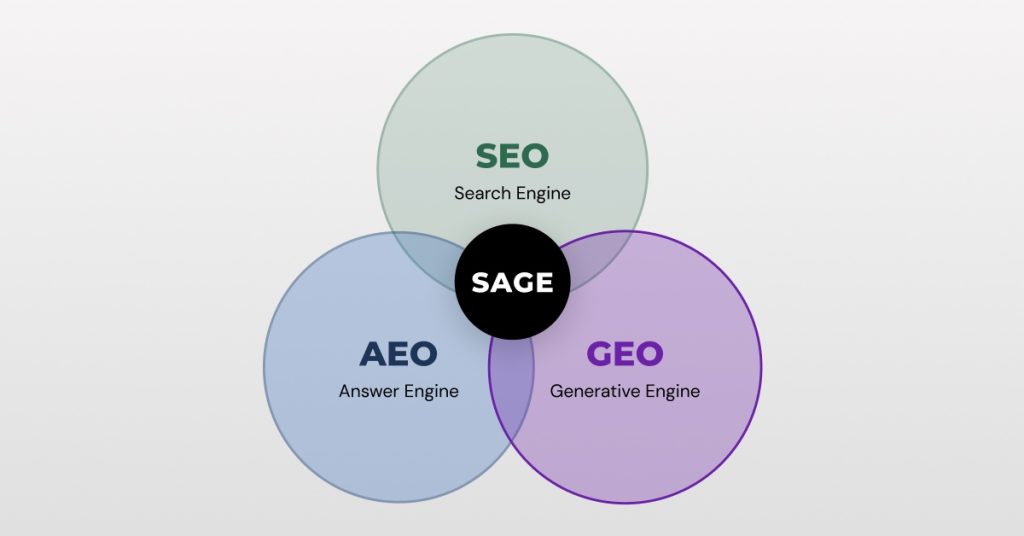
The SAGE programme for this client focused on three interconnected objectives: establishing technical foundations for organic search, building topical authority in the brand's product category, and capturing AI search visibility for the discovery-stage queries that paid media was too expensive to target at scale.
Technical Foundations
A comprehensive technical audit identified forty-three actionable issues affecting crawlability and page performance. These ranged from duplicate content problems on product category pages to images lacking alt text, JavaScript-dependent content that AI crawlers could not parse, and page loading times that were above the threshold for Core Web Vitals compliance. All critical issues were resolved in the first six weeks of the programme.
Topical Authority: The Content Hub
The brand launched a content hub addressing the buyer questions and lifestyle topics most closely aligned with their product category. Rather than producing generic branded content, the hub was structured around the genuine questions their target buyers were asking — validated through keyword research, customer interviews, and analysis of the 'People Also Ask' boxes appearing in search results for category queries.
The content was structured for both reader value and AI extractability: clear H2 structures, answer-first opening paragraphs, FAQ sections with schema markup, and specific data points sourced from published research. Twelve substantial articles were produced in the first three months, covering the full informational arc from category education through to purchase decision support.
AI Search Presence
Schema markup was implemented across the site, including Product, Organization, FAQPage, and Article types. The brand's presence on third-party platforms — review sites, lifestyle publications, social channels — was audited for consistency and completeness. Three content collaborations were arranged with credible lifestyle and category-specific publications, generating external links and citations that strengthened the brand's authority signals for AI platforms.
Results at 12 Months
Organic Traffic Growth
Total organic search traffic increased by 218% over the twelve-month period. Direct organic traffic to the content hub reached 24,000 sessions per month by month twelve, from zero at the programme's start. Seventeen article pages achieved page one rankings for their target queries, including four in the featured snippet position.
AI Search Visibility
The brand appeared in AI-generated responses on Perplexity for eleven category queries — including six discovery-stage queries representing buyers at the earliest stage of the purchase consideration process. Google AI Overviews featured the brand's content in responses to five product category queries. The brand was cited in ChatGPT responses to three category recommendation queries tested during the audit.
Paid Media Impact
With organic discovery increasing, the brand was able to reduce paid search spend on top-of-funnel awareness campaigns by 40% while maintaining equivalent new customer acquisition volumes. The budget freed by this reduction was reallocated to bottom-of-funnel retargeting, which became more efficient as brand awareness and recognition improved through organic channels.
Total digital marketing cost-per-acquisition decreased by 34% over the twelve-month period.
Revenue Impact
Organic search became the brand's second-largest customer acquisition channel by month nine, overtaking social advertising for the first time. Customers acquired through organic search had an average order value 22% higher than paid search customers, a pattern the brand attributed to the pre-qualification effect of educational content — buyers who had consumed category and product guidance content before purchasing were more confident and more likely to choose premium options.
KEY INSIGHT
The most striking insight from this engagement was the compounding dynamic. By month twelve, the organic traffic gains were accelerating rather than plateauing. The authority built in months one through six was generating additional authority in months seven through twelve. Paid media performance, by contrast, required constant spending to maintain results. Organic search was becoming a self-reinforcing asset.
Why This Works: The Economics of Owned Visibility
Paid media is a variable cost. Spend stops, results stop. Organic search is a capital asset. Effort invested today generates returns tomorrow, next year, and the year after. The economics are fundamentally different.
A business that has built strong organic search visibility has created a customer acquisition channel that does not require ongoing payment for each impression and click. The cost of maintaining that channel — producing continued content, maintaining technical standards, building authority through partnerships — is substantially lower than the cost of generating equivalent visibility through paid media.
More significantly, organic and AI search visibility creates a different kind of buyer. Someone who found your brand through a paid advertisement is a buyer you interrupted. Someone who found your brand because an AI recommended it, or because your content appeared as the authority on a question they were researching, is a buyer who was guided to you. The psychological context is entirely different — and the conversion rates, deal sizes, and retention metrics reflect that difference.
QUICK WINS: WHAT YOU CAN DO THIS WEEK
- Calculate what percentage of your current new customer acquisition is paid versus organic. If paid exceeds 70%, you have a significant dependency risk worth addressing urgently.
- Map your five highest-volume product or service category search terms. Are you ranking organically for any of them? If not, each one represents a stream of buyer intent you are not capturing.
- Review your product or service pages for buyer-question content. If the pages only describe what you sell rather than answering why a buyer should choose it and how it solves their specific problem, they need restructuring.
- Identify one or two credible industry or lifestyle publications relevant to your category. A contributed article or product feature with a link back to your site will have lasting SEO and authority value.
- If you have strong customer reviews, structure them for AI visibility. Specific, outcome-focused testimonials are vastly more likely to be cited by AI systems than generic positive feedback.
READY TO TAKE ACTION?
Paid media will always have a role. But if it is your primary discovery channel, you are renting visibility you could own. SAGE is how you make the transition — systematically, measurably, and with a clear ROI framework. Book a SAGE Strategy Session at brandcore.sg to understand exactly what owned search could look like for your business.